Futures
Written By Ehsaan XP
Last updated 6 months ago
How to connect the API key with Futures Permission
Binance USDT-M:
Log in to Binance and open a Futures Account at https://www.binance.com/en/futures.

Proceed to the API Management page:
Click the profile icon in the top right corner and select "API Management".
Generate an API Key with necessary permissions:
Turn off "Default Security Controls for Unrestricted API Keys" in API Management, create a new API key, and enable Reading, Spot & Margin Trading and Futures in API Restrictions.
Copy and paste your API Key:
Copy the API Key and Secret Key (e.g., s7UPj1hmzjCoys8732) and paste them into the corresponding fields in SageMaster to start trading on Binance.

Need help? Check SageMaster Full Guide or just contact us via chat (icon in the right bottom corner)!
The difference between spot and futures
Spot Trading: Ideal for long-term investors who want to own the actual cryptocurrency. It is simpler and involves less risk due to the absence of leverage.
Futures Trading: Suitable for experienced traders who want to speculate on price movements and are comfortable with higher risk levels due to leverage. Futures trading offers opportunities to profit from both rising and falling markets.
Understanding the distinctions between spot and futures trading can help you choose the right approach based on your investment goals, risk tolerance, and trading experience.
Spot Example: If you buy 1 Bitcoin (BTC) at $30,000 on a spot exchange, you immediately own that 1 BTC, and it is stored in your wallet.
Futures Example: If you enter into a futures contract to buy 1 Bitcoin at $30,000 with 10x leverage, you only need $3,000 as margin to control the position. If the price of Bitcoin rises to $33,000, your profit would be $3,000 (a 100% return on your initial margin), but if it drops to $27,000, you would lose $3,000 (your entire margin).
Comparing Spot and Futures Trading
The main terms and calculations that are worth your attention

Position Type:
Long Positions: When you go long, you expect the asset's price to rise. If the price increases, you can sell the contract for a profit.
Short Positions: When you go short, you anticipate the asset's price to fall. If the price drops, you can buy the contract at a lower price, gaining the difference.
Both Positions: DCA can open as Long as Short positions. Available for Select Indicator Provider
Isolated Margin Mode:
In isolated margin mode, each position has its own margin. This means that the funds allocated to a specific position are separate from the rest of your account balance. If a position is liquidated, only the funds in that position are at risk, protecting your overall account balance.
Benefits of Isolated Margin Mode:
Risk Management: Limits the potential loss to the margin allocated for each position.
Flexibility: Allows you to manage different positions independently.
Leverage Level:

Leverage allows you to control a larger position with a smaller amount of capital, amplifying both potential gains and losses. Binance offers various leverage levels, ranging from 1x to 75x.
How Leverage Works:
1x Leverage: No leverage; you trade with your own funds.
10x Leverage: For every $1 you deposit, you can trade $10 worth of contracts.
75x Leverage: For every $1 you deposit, you can trade $75 worth of contracts.
Example: If you have $100 and use 10x leverage, you can open a position worth $1,000. If the asset's price moves 1% in your favor, your profit would be $10 (10% of your initial $100). Conversely, if the price moves 1% against you, you would lose $10.
Liquidation Price :
The price at which the position will be liquidated if the market price reaches this level
Contract Value:
The Contract Value is the total value of the position, calculated as the number of contracts multiplied by the contract size and the current market price.
Position Margin (Initial):
Position margin is the minimum value you must pay to open a leveraged position. For example, you can buy 1,000 BNB with an initial margin of 100 BNB (at 10x leverage). So your initial margin would be 10% of the total order. The initial margin is what backs your leveraged position, acting as collateral.
More information about Binance Futures can be found here:
What Are Perpetual Futures Contracts?
How to set up and run a DCA Assist on Binance Futures?
Go to this page https://app.sagemaster.io/ai-assist/dca/create
Select the Futures account
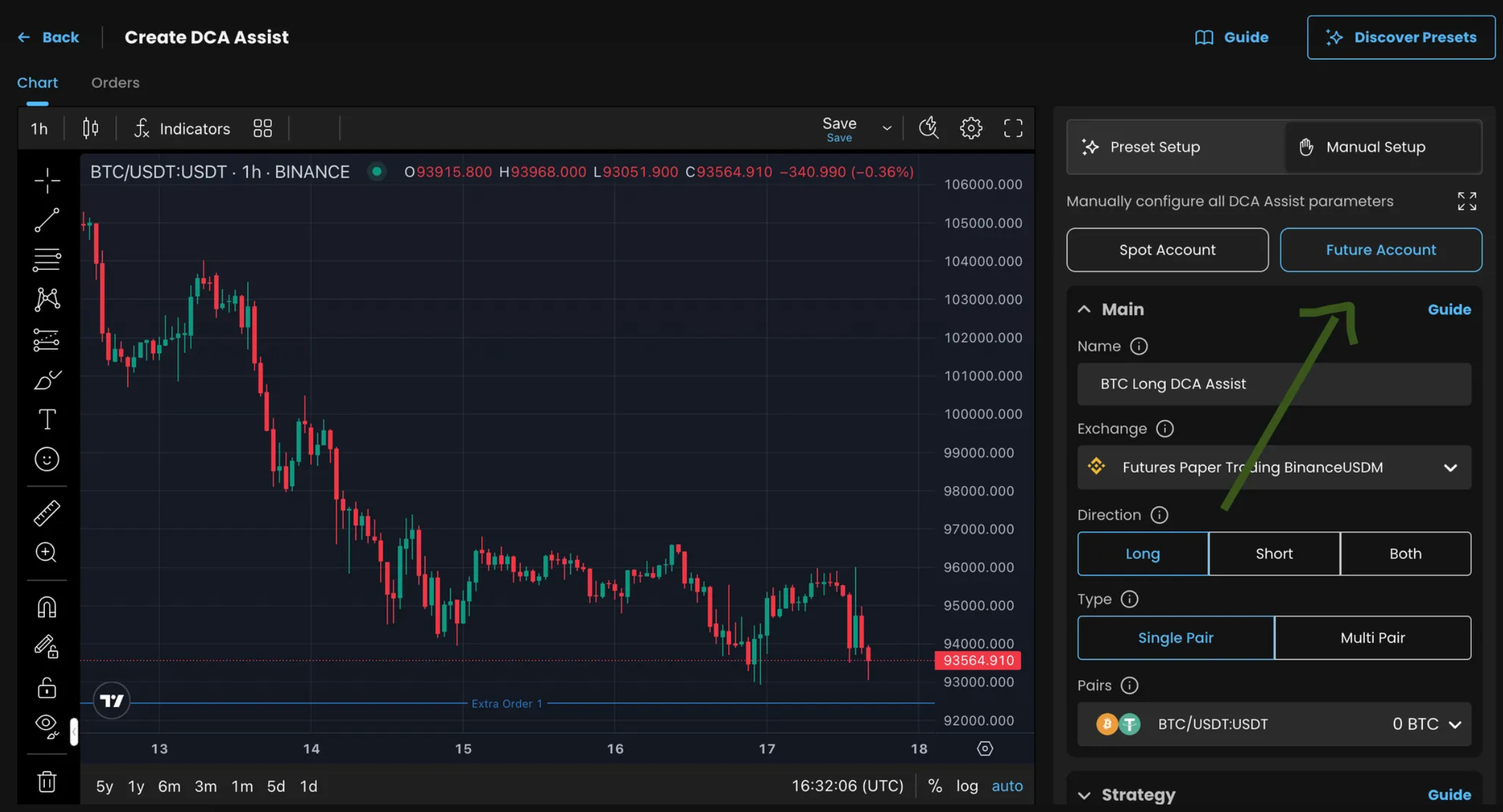
Select the Single or Multi-pair type for trading and select the pairs for trading
Set up a strategy and choose your margin parameters:
Position Type - Long, Short, Both
Leverage Level
Then you need to set other needed settings for the bot such as Take Profit, Stop Loss, Extra orders, and trigger conditions
FAQ
Which exchanges are available for Futures trading?
Binance USDM, Bybit, Bitget, Hyperliquid
Which Assists have futures support?
DCA
Why can't I cancel a futures trade?
There is no option to cancel an open position on futures. Therefore, even if you cancel the trade, the position will remain open You can go to the exchange and cancel the open order and close the position if necessary. Or use the opportunity to close the trade at the market price
How does leverage work in trading?
Leverage in trading allows you to control a larger position with a smaller amount of capital. A leverage of 2:1 means that for every $1 you have, you can control $2 of a trading position. Similarly, a leverage of 10:1 means you can control $10 for every $1 you have.
The money doesn't actually come from the exchange , but rather it's borrowed from the exchange to open larger positions. The exchange provides the leverage as a service, allowing traders to amplify their potential profits or losses. It's important to note that while leverage can increase potential gains, it also magnifies potential losses, so it should be used with caution and proper risk management.
How to calculate minimum order amount?
Our system has the following validation from the exchange side.
Should calculate cost price:
For long positions: Cost Price = ∑ (Buy Quantity Buy Price) / Position Size (since the initial position was opened) In this case, any additional long positions following the initial position will be accounted for and recalculated to determine the new cost price.
For short positions: Cost Price= ∑ (Sell Quantity Sell Price)/ Position Size (since the initial position was opened) In this case, any additional short positions following the initial position will be accounted for and recalculated to determine the new cost price. A weighted average takes into account the quantity and price purchased with each trade. In other words, if you buy an additional 2 BTC, the price you pay will affect the average more than if you bought 1 BTC. When a position returns to zero or changes direction, the cost price will be recalculated.